
The whole argument, including where it stops.
Twenty sections. Every one of them carries a number, a named process or a measurement — and the last four are about what this fibre will not do.
Why not polyester
Polyester is polyethylene terephthalate — the same polymer as a drinks bottle, drawn into a filament fine enough to knit. It is cheap, it is strong, it dries fast, and roughly two thirds of all clothing made today is built from it.
It is also plastic worn against skin, and it does not stop being plastic at the end of its life. A polyester legging buried in landfill is still a polyester legging in several centuries. Nothing about that is controversial; it is simply not usually printed next to the price.
We are not arguing that polyester performs badly. It performs extremely well, which is exactly why it won. We are arguing that for the things most people actually do in activewear — Pilates, lifting, walking, a class, a commute — the performance ceiling of a well-made natural cloth is higher than the industry has bothered to find out.
Zero synthetics
No polyester. No nylon. No elastane. No recycled PET, which is still PET. No polyurethane coating, no silicone grip tape, no bonded seam tape, no synthetic sewing thread.
That last one matters more than it sounds. A garment sold as cotton is very often sewn with polyester thread, because polyester thread is stronger and cheaper and nobody checks. Every seam in this range is sewn with organic cotton thread instead, which is weaker — so the seams are constructed differently to compensate.
There is exactly one component in the range that is not a fibre: the metal zip on the Hood and the Zip-Up, mounted on a cotton tape. We have left it in because it can be replaced by any tailor, and hiding it would be worse than naming it.
Extra-long-staple cotton
Staple length is how long an individual cotton fibre is before it is spun. Ordinary upland cotton runs around 26 mm. Extra-long-staple runs past 34 mm.
Longer fibres mean fewer ends poking out of the yarn. Fewer ends mean less pilling, a smoother hand, and — the part that matters for activewear — a yarn that can be spun finer at the same strength. A finer yarn knits to a denser fabric at the same weight, and density is what gives a cotton garment opacity under stretch.
It costs more. It is the single largest line item in the cloth, and it is the reason the range is priced where it will be.
Yarn twist and compacting
A yarn is fibres twisted together. Too little twist and it sheds; too much and the cloth goes hard and loses stretch. The range sits deliberately toward the higher end, then the knitted fabric is compacted afterwards to bring the hand back.
Compacting is a mechanical process — the cloth is fed through rollers under steam and physically shortened before it is cut. It is the reason these garments do not shrink in your machine: the shrinkage has already been taken out at the mill.
Natural rubber elastic
Every waistband and every bra band in the range carries a tape of natural rubber, tapped from a tree, encased inside a knitted cotton channel so it never touches skin and never meets detergent directly.
Natural rubber is not elastane. It has less elongation and it does not like heat, which is why the care instruction about tumble dryers is a real instruction and not boilerplate. In exchange it is a plant product, it biodegrades, and it does not shed a filament every time it is washed.
It is used only where a band has to return to length. Nowhere in the range is rubber knitted through the body of a garment — the stretch you feel in the cloth itself is structural, from the rib, not chemical.
Organic cotton thread
This is the detail that quietly disqualifies most "100% cotton" activewear. Polyester sewing thread is standard across the industry because it is stronger than cotton thread at the same diameter, and because a thread is invisible in a photograph.
Cotton thread is weaker. Building with it means flatlocking rather than overlocking, bar-tacking the stress points, and accepting a slightly heavier seam. All three of those choices are visible if you turn a garment inside out, which is the only reliable way to tell whether a claim like this one is true.
The graded bra shelf
A shelf bra in most garments is a strip of the same jersey folded over and stitched down. It supports nothing; it exists so the garment can be sold without one.
The shelf here is a second full layer of the same rib, seamed at the underbust, carrying its own encased rubber band. Support comes from the band — the straps only stop the garment sliding down. That is how a bra actually works, and it is why the band is 38 mm rather than 12 mm.
Rib-knit recovery
Recovery is a fabric's ability to return to its original dimension after being stretched. Elastane does it chemically. A rib knit does it structurally — the fabric is folded into itself at the loop level, so stretching it unfolds a pleat rather than extending a fibre.
This is why every load-bearing piece in the range is ribbed and not jersey, and why the rib runs vertically in the leg pieces: it stretches across the leg, where you need give, and recovers along the leg, where you need length to hold.
It is genuinely less elastic than elastane. It recovers more slowly and it recovers less far. What it does not do is fatigue — an elastane band has a fixed number of cycles in it, after which it is finished. A rib does not have that failure mode.
Band and strap grading
Most activewear is graded by scaling one pattern up and down. It is fast, it is cheap, and it is why a 3XL so often looks like an XS that has been photocopied at 160%.
Band width, shelf depth and strap placement are graded independently of the body here. A larger size gets a wider band because a wider band is what a larger frame needs — not because the whole pattern grew.
The practical result is that the underbust seam lands on the underbust across all eight sizes, which sounds like the minimum and is not the norm.
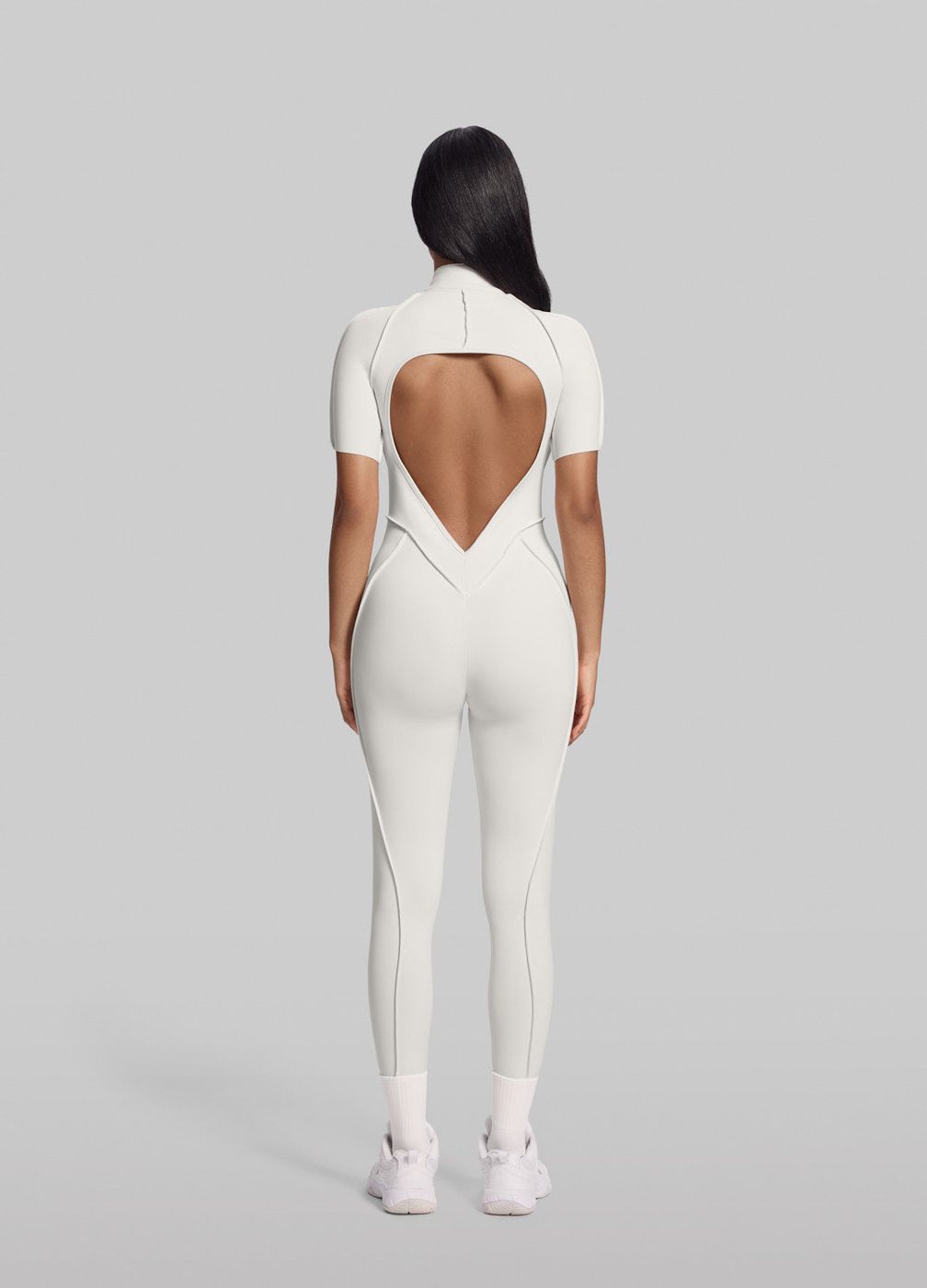
Engineered for D/DD+
From L upward the shelf gains a third layer through the cradle and the strap widens from 16 mm to 22 mm. Both changes are there for the same reason: past a certain volume, support has to come from surface area rather than from tension.
This is a shelf-bra range, not a bra range. It is rated for low to medium load, and above a certain cup that ceiling comes down rather than up. We would rather write that here than let someone find out in a class.
How we test fit
Every size in the range is fitted on a person of that size, not on a graded block and a fit model in the middle of the run. That is slower and it is the only way the ends of a size range come out right.
The fit council is the group of people who do that. It is open, it is unpaid, you keep the samples, and you are asked to be blunt. If you want the garment to fit you specifically, this is the way to make that happen.
Single-origin cotton
The cotton for the first run comes from one growing region and is spun at one mill. Not because single-origin is inherently better cotton, but because it is the only way to answer a question about a specific garment with a specific answer.
Blended commodity cotton cannot be traced. Once lint from four countries is mixed at the gin, no certificate downstream can tell you where any particular garment came from — it can only tell you the average.
The grower, the gin and the spinner will be named on this page. They are not named yet, because we are not going to publish a name we have not signed with.
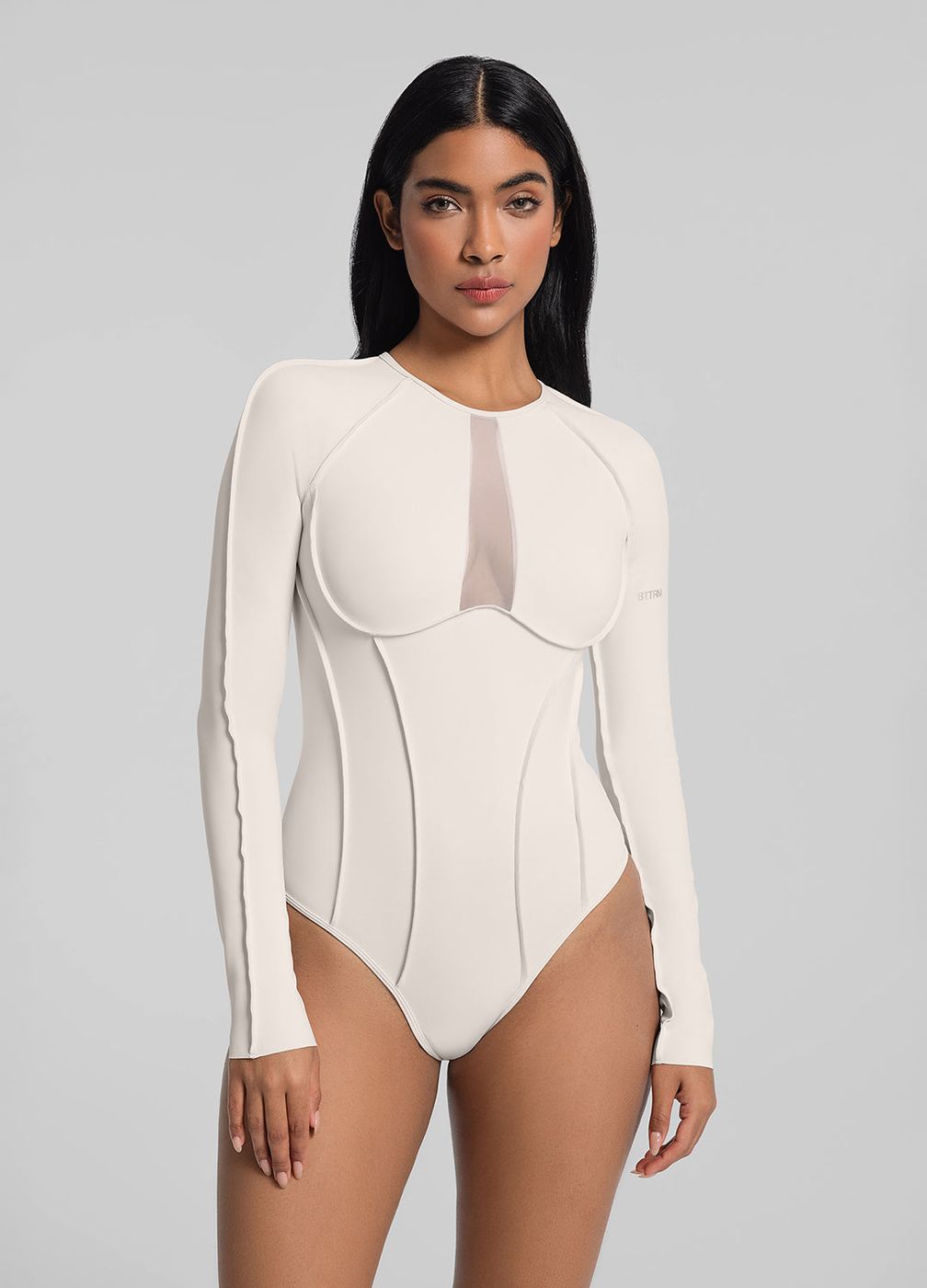
Dyeing and finishing
Gardenia is not dyed at all. It is the colour cotton is, which is not white — it is a warm off-cream, and it varies slightly between runs in the way a natural material does.
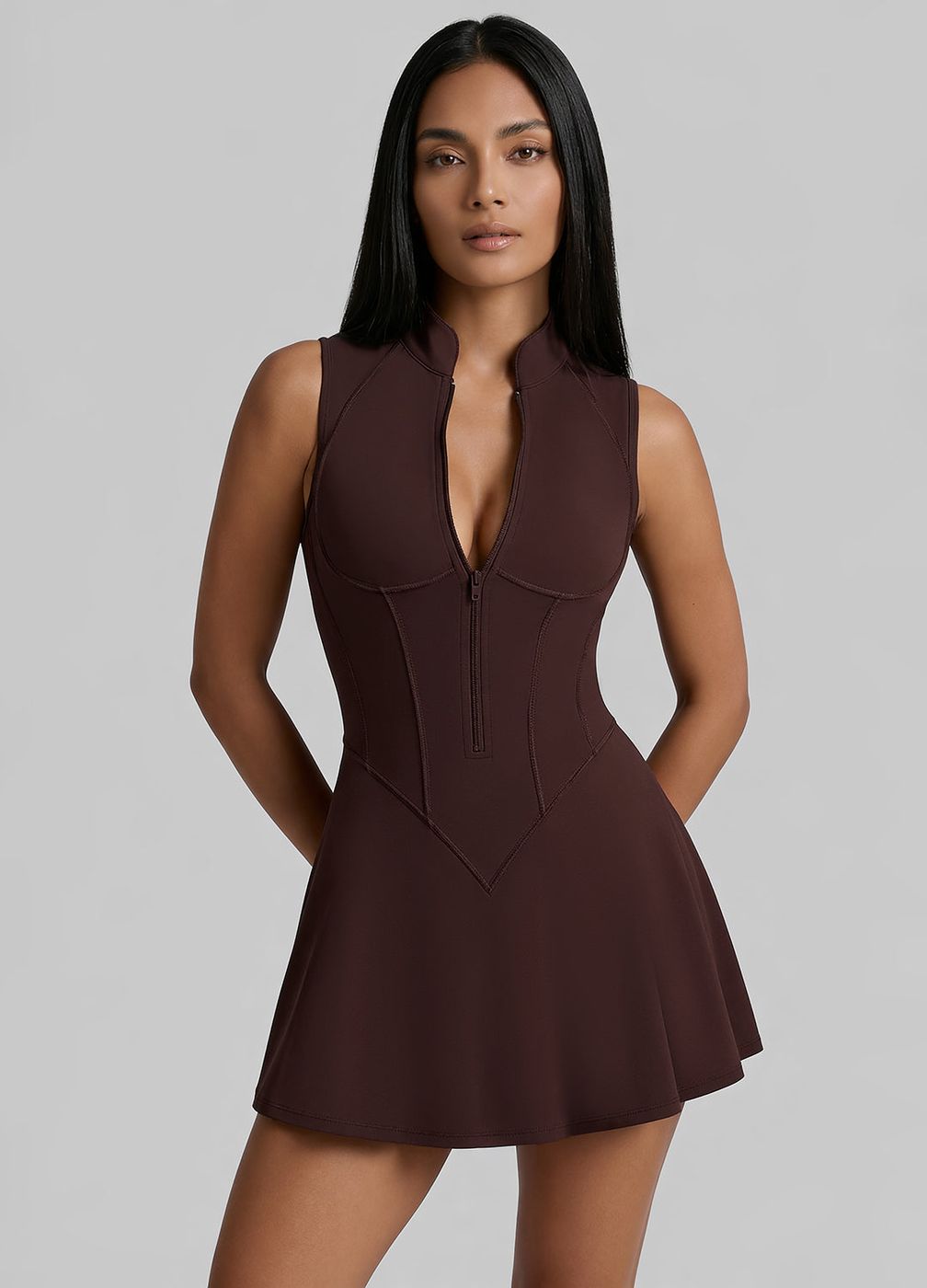
Chocolate and Bougainvillea are dyed once, with no bleaching step beforehand. Bleaching before dyeing gives you a brighter, more repeatable colour and it costs the fibre strength, so the range accepts a slightly less consistent shade instead.
No optical brightener is used anywhere. Optical brightener is a fluorescent dye that makes white cloth look whiter by re-emitting ultraviolet light; it is why a lot of "undyed" cotton looks suspiciously bright.
The 20-wash test
Every piece in the range goes through twenty domestic wash cycles before it is signed off, and is measured before and after for length, width, band recovery and colour.
Twenty is not an arbitrary number — it is roughly a season of real use for a garment somebody likes. Most fabric testing is done at three or five cycles, which is the point at which nothing has gone wrong yet.
The measured results will be published here as a table, per piece. They are not published yet because the current run is at cycle eleven.
Microfibre shedding
Every fabric sheds in the wash. The difference is what the shed fragment is. A cotton fibre fragment is cellulose and it breaks down; a polyester fragment is a microplastic and it does not.
So the honest claim is not that this range does not shed. It does. The claim is that what comes off it is plant material, and that a wash load of it does not add microplastic to a waterway.
The shedding rate will be measured under a published protocol and the number will appear here. Anything before that would be a guess with a decimal point on it.
End of life
Cotton, natural rubber and cotton thread all biodegrade. That is a property of the materials, not a certification, which is why it is stated here rather than badged.
Two honest caveats. Dyed cloth carries dye, and how a dye behaves at end of life depends on the dye. And the zip on two pieces is metal, so it has to come off first — which takes about a minute with a seam ripper.
The conditions and the timeframe matter enormously and are frequently left out. A garment in a sealed landfill does not biodegrade meaningfully regardless of what it is made of. The claim here is about the material, not about magic.
What cotton is not for
Cotton absorbs water and holds it. That is the whole limitation and everything else follows from it.
It means this range is not for distance running, not for hot yoga, and not for anything where you will be soaked for an hour and then cold. A synthetic will out-perform it in every one of those, decisively, and we are not going to pretend otherwise.
It is for Pilates, lifting, barre, walking, class, travel and the large amount of time that activewear is worn while not training. That is most of it, for most people, most of the time.
Compacting and shrinkage
Cotton shrinks. Compacting takes most of it out before the cloth is cut, but "most" is the operative word — expect under 2% in length on the first wash, and expect it to be over after that.
Follow the cold-wash instruction and it stays there. Put it through a hot tumble dryer and you will get the rest of the shrinkage in one go, along with damage to the rubber in the band. That is not a warranty position, it is just what happens.
Care and washing
Cold, 30°C, inside out. Line dry or dry flat. Warm iron on the reverse if you want to.
Do not use fabric softener. Softener works by depositing a thin waxy film on the fibre, which is exactly the absorbency you paid extra for. It also gradually stiffens natural rubber.
Do not tumble dry hot. Heat is the one thing that shortens the life of both the cotton and the band.
What we haven't solved
A running legging. Cotton wet through at kilometre six is a genuinely bad garment and we do not have an answer.
A high-impact bra. Shelf construction tops out well below what high impact requires, and building a real one without synthetics is an unsolved problem, not a roadmap item.
Weight. Every piece in this range is heavier than its synthetic equivalent, because weight is how a natural fibre achieves opacity and recovery. If that is the wrong trade for you, it is the wrong range for you, and that is a reasonable conclusion to reach.
That is the argument.
If a claim on this page is not backed by a number, a named process or a measurement, write and tell us. We will correct it or remove it.